My new book, Mythological Storytelling is available for purchase! Check it out:
As a fiction writer, the goal is to create a story that resonates with the audience. We all want to write something gripping that people will share with friends and family; a narrative that lasts with the reader for years to come. Unfortunately, this is easier said than done. Many of us start out with a passion for storytelling. We love exploring new worlds and developing complex characters. So we begin to write. But at some point, every storyteller realizes that in order to become a professional, we must hone our natural talent into a skill. So, what do we do? We buy books on writing. There’s a book out there for everything. Some teach plot, others character. There are books that explain how to write action, suspense, conflict, dialogue, setting, theme, etc...
But no matter how logical we structure our story, or how perfectly we construct our prose, the story doesn’t seem to have that “X-factor.”
Even well known professionals face this problem. Think about how many times you’ve gone to the movies or picked up a book by a writer you follow, or a franchise you love, only to be completely let down. How many forgettable novels or films have you come across in your lifetime? Some written by reputable authors and screenwriters. Even though the action, mystery, or romance was great, the story still fell flat. The narrative lacked some mystical element that every great story seems to inherently possess.
This is the major problem every author, writer, poet, screenwriter, and storyteller face.
The Modern Monomyth series is aimed to teach writers from all walks of life how to fuel their stories with the power of myth. By utilizing mythological elements from the Monomyth (also known as the Hero's Journey), authors are able to connect with their audience on a deep psychological level.
This book provides a definition of the Monomyth and it’s early origins. It teaches the three act structure as it pertains to the Hero's Journey and explains the difference between the known world and the special world of your story. You’ll learn what really makes a character heroic, and how plot and character feed off of each other, creating both an inner and outer journey. We’ll outline the 18 distinct stages of the hero’s journey and briefly discuss the main archetypes of the Monomyth. For each stage, this book provides at least four modern examples from well known stories. Each example will help you understand Hero’s Journey, and help you identify the stages in your own book. Every chapter concludes with action steps, which you can immediately use on your story. These will help you infuse mythic power and life into the narrative. By the end of the book, you’ll have a basic understanding of the Monomyth and a road map for your own story.
Follow Josh!!!
Instagram: @Joshumusprime
Facebook: Josh Coker
YouTube: @Tipperdy
Twitter: @Joshumusprime
LinkedIn: Joshua Coker
Amazon: Josh-Coker
Showing posts with label writer. Show all posts
Showing posts with label writer. Show all posts
Thursday, June 1, 2017

Monday, July 6, 2015
What is the Monomyth? An introduction to the Hero's Journey

Yes, they’re all Hollywood blockbusters.
Yes, they all made hundreds of millions of dollars.
However, when we look at the narrative, the main aspect that each has in common, is that they all follow the Monomyth format.
What is the Monomyth you say?
Well I’m glad you asked, because today’s post will serve as an overview of the the Monomyth. First will discuss meanings and origins. Second we’ll look at the basic components of the monomyth. And third, we’ll discuss why the Monomyth is important for everyday life.
- WHAT IS THE MONOMYTH?
Monomyth Definition: The word comes from two Greek root words. Mono, meaning “one,” and mythos, meaning “story.” So when you combine the two, you get the “one story.” The connotation being that there is one underlying structure to all stories. In recent years, the term has become synonymous with the “Hero’s Journey.” Additionally, it has loose connections with the “Fool’s Journey,” which is used in Tarot.
 |
| Statue of Giglimesh |
The monomyth seems to be as old as humanity itself. Aspects of the monomyth can be seen in stories throughout human history. Although, several academics studied this idea throughout the ages, it wasn’t really popularized until 1949, when Professor Joseph Campbell published the book, The Hero With A Thousand Faces. Campbell was a professor of mythology and spent his life studying all of the ancient stories and fairytales. His research found that each followed a similar template. Furthermore, he stated that every step in the process had a connections with human psychology. Since then, numerous other books have been written on the subject. Moreover, several stories, movies, and even video games were written following the monomyth template. Hence my early question about Star Wars, Harry Potter, and Hunger Games.
 |
| Professor Joseph Campbell |
2. WHAT COMPRISES THE HERO’S JOURNEY?
A three act structure. Although Joseph Campbell identified roughly 17 specific steps to the Hero’s Journey, the base steps are comprised of a three act structure. Others, such as screen writer Chris Vogler, author of The Writer’s Journey, partitions them even further. However, the three main steps are as follows: Separation: First the hero must leave his normal world by accepting the call to adventure, meeting helpers/mentors, and cross the threshold into the special world. Initiation: Second the hero must face the road of trials, enter the proverbial belly of the whale, face death and receive the ultimate boon. Return: Lastly the hero must return to the normal world to share the boon with others.
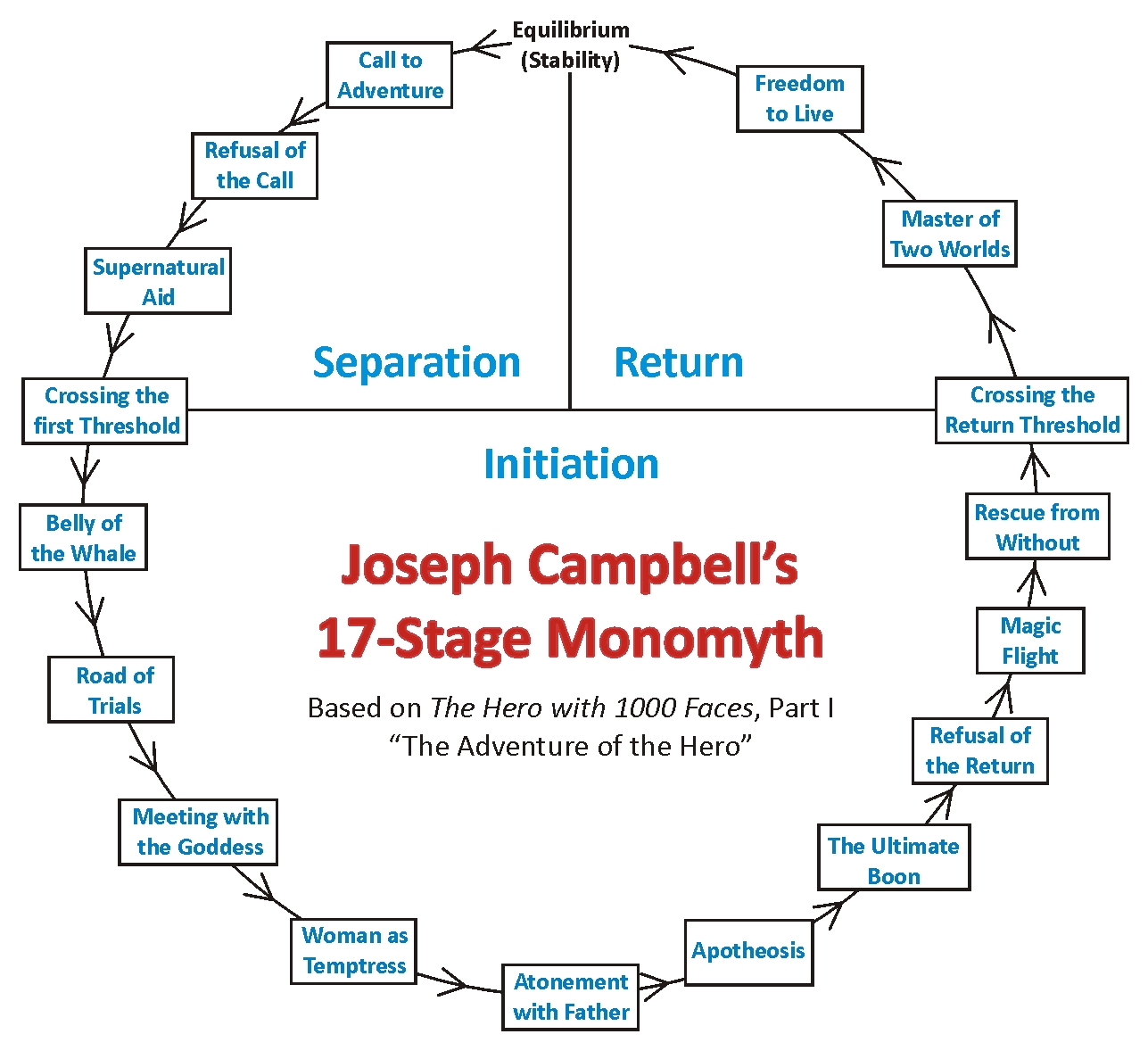
Also archetypes. Aside from the three main plot events, the monomyth is comprised of several archetypes. These are characters that fulfill major roles in the story and represent a psychological mechanism all humans face. The hero, mentor, and villain are just a few of the basic archetypes that comprise the monomyth.
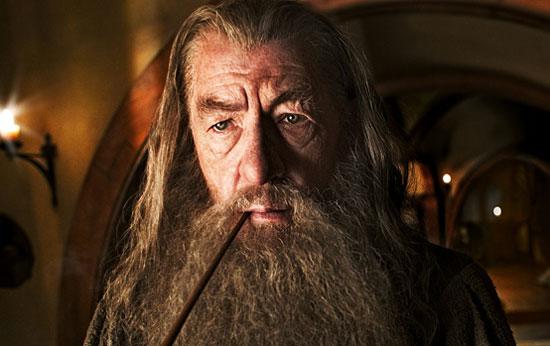 |
| Gandalf is the epitome of the mentor archetype. |
3. WHY IS THE MONOMYTH IMPORTANT?
Helps writers write, right. On the surface level, the monomyth is a great tool for storytellers. It is great template to structure their work on. It also provides the writer a map to reference if they feel their story has gone off of the beaten path.

Gives us insight into our own lives. On a deeper level, the monomyth helps us evaluate our own lives. Whether you’re writing a novel, going out on a date, or giving a job interview, we all tell stories everyday. But what we don’t realize is that all of us are living a story. The story of our life. For example, when a young man or woman accepts the call to adventure and joins the military, they leave their normal world. They are confronted with new obstacles and challenges in the proceeding years. And at some point, they leave the military and return back to society. Changed forever, by their experiences. Moreover they use the lessons they learned to make the normal world a better place.The same thing happens to students who attend a new school. Or a couple who become parents. On a personal level, the monomyth provides us a means to regard our own narrative. To help us understand our failures and successes in a meaningful way.

CONCLUSION
Again this was just a very simple overview. But the three key take-aways are as follows, 1) Monomyth means the “one story,” and elements of the monomyth can be found in nearly all forms of mythology and fairy tales from around the world; 2) It’s comprised of a three act structure, and has several recurring archetypes; 3) it’s basic uses are for writing and story structure. However, many people find it as a helpful tool in deciphering life experiences and gaining a deeper understanding of their own life’s story.
As I mentioned before, this post is just to cover the the basics of the Monomyth. Over the course of the next few months I intend to provide several in depth explanations on the different aspects of the Hero’s Journey, and analyze more advanced steps in the narrative structure.
If you’d like to hear more about the Monomyth and Hero’s Journey, feel free to watch my YouTube video on it here:
Follow Josh onYouTube here: https://www.youtube.com/user/Tipperdy
Or Twitter: @Joshumusprime
Or Twitter: @Joshumusprime
Or Facebook: www.facebook.com/thepolymathparadigm
And you can his NaNo progress here: http://nanowrimo.org/participants/tipperdy
And he has a book on military transitions here: http://www.amazon.com/About-Face-Josh-Coker-ebook/dp/B00N4GYB84/
Saturday, April 4, 2015
3 Way's Information Technology Changed How Authors Write Novels

As an author, information technology has flipped the script on how we write. The three major areas it helps are: 1) rough drafts, 2) collaboration, 3) publishing.
With that being said, let me provide some examples.
Drafting
The key to rough drafts are speed. The faster you get words on paper the better. I call it word-vomiting. In the past I used to hand-write or type out rough drafts. The problem is, you think much faster than you can type or write. If you’re not fast enough, you can lose some great ideas. However, now that smartphones have a dictation feature speed is a non issue. You can talk much faster than you write or type and the phone will capture the nearly all of your words. Despite the fact that a degree of fidelity lost in translation this is still far more effective for the rough draft. You can easily mitigate errors in future drafts and editing.
Collaboration
After your drafts are done, you eventually need to send your work to an editor. In the past this used to be a cumbersome process of e-mailing back and forth. Version control can quickly become problematic. However, with collaboration tools like Google Docs, Google Hangouts, Skype, and MS Project (to name a few), teams can quickly coordinate in near real time. This speeds up the process and while allowing effective collaboration.
Publishing
Lastly, publishing has always been the bane of a writer’s existence. Particularly new authors. Although many are great at creating engaging stories, they’re not that skilled at obtaining legitimate publishers. However, with the advent of self-publishing and it’s adoption by behemoth companies like Amazon, information technology has provided a great venue for first time authors to showcase their work. Furthermore, large publishing houses can rate “new talent” based on real life sales, opposed to taking large risks with no name authors.
What about you? How do you use technology to write in the 21'st century?
PS.com... If you want to see more on this topic, and why I believe everyone can write their own book, check out the following video:
Follow Josh onYouTube here: https://www.youtube.com/user/Tipperdy
Or Twitter: @Joshumusprime
Or Facebook: www.facebook.com/thepolymathparadigm
And you can his NaNo progress here: http://nanowrimo.org/participants/tipperdy
And he has a book on military transitions here: http://www.amazon.com/About-Face-Josh-Coker-ebook/dp/B00N4GYB84/
Friday, October 31, 2014
NaNoWriMo (National Novel Writing Month) 2014

And today we're talking about a topic that I love...
NaNoWriMo
Any of you guys know that is? I think some of you do, but for those of you that don't, I will tell you. Have you ever imagined your novel sitting on the bookshelves of Barnes and Noble? Right next to Hemingway, or Orson Scott Card? Well now is your chance! Because November is National Novel Writer's Month. Hence, "NaNoWriMo." For the neophytes in the room, let me elaborate. Essentially writers from around the wold get together and pledge to write a novel; at least 50,000 words! Now this is the prime opportunity for you to write a story. If you've been waiting and putting it off, or said, "Awe I can never be an author." This is the prime time to prove that theory wrong.
Let me tell you why.
First, you're gonna have tons of support. There are lots of people on the interwebz and the YouTubez (like me) giving all kinds advice; showing you the ropes. Also there are local communities throughout the various states and regions. Each with their own liaisons and writers groups. Here you can mingle with other writers who are going through the same struggles; the same tribulations; the same writers block. You meet some wonderful people. It's one of the greatest experiences I had. My first novel, I had been struggling to for over a decade. Then I decided to do NaNo (based on a friends relentless nagging...) and less than thirty days, I had the first draft completed! I was so pumped because finally I had accomplished this lifelong goal that seemed to allude me. The words were on the paper. I could see the proof; the fruits of my labor. To top it off, there was a nice winners certificate that they gave me. I got to show it off to everybody on Facebook and Twitter. What a badass I was...
It was wonderful.
It was wonderful.
If you've ever considered writing a novel, highly recommend. Just in case, I've listed all of the pros and cons here on my YouTube channel:
Anyways, National Novel Writing Month Just started a few minutes ago, so I better get to typing...
If you'd like to follow my progress or learn more about NaNoWriMo, checkz outz the following linkz belowz.
Follow Josh on Twitter: @Joshumusprime
Or Facebook: www.facebook.com/thepolymathparadigm
And you can his NaNo progress here: http://nanowrimo.org/participants/tipperdy
And he has a book on military transitions here: http://www.amazon.com/About-Face-Josh-Coker-ebook/dp/B00N4GYB84/
Monday, May 12, 2014
10 Strange Things You Didn't Know About Edgar Allan Poe
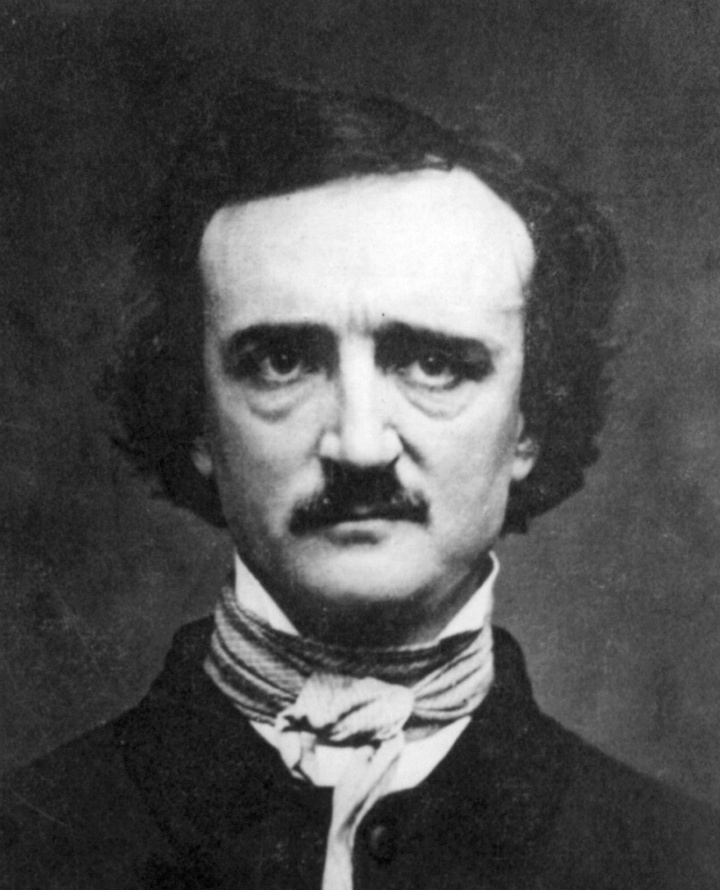
- By the time he was three he was an orphan.
- Some scholars believe his dad abandoned the family, while others note that he may have died.
- Poe started writing poetry and criticisms at the ripe old age of 13.
- Because of poor money management he only attended college for a semester.
- He joined officer school at West Point Military Academy to pay off gambling debts.
- Soon after, his drinking habits caught up with him and he was kicked out!
- He only turned to writing as a job after becoming desperate for work.
- He married his 13 year old cousin and lived with her for 7 years until she died an untimely death at the hands of tuberculosis.
- Because several of his stories are told from the first person point of view, and because the characters know intimate details of drug use, several critics believe that Poe was pulling from his own personal experiences.
- According to myth, he died under mysterious circumstances which many attributed to his heavy use of alcohol.
Needless to say, Poe's life (and death) was as sad, mysterious, and crazy as his writing.
Saturday, May 3, 2014
Sherlock VS Hannibal: Fun With Dialogue Exercises


As a fiction writer, sometimes it's good to flex your creative muscles by taking material from well known characters and mixing it up. It allows you to play with words and use characters that normally wouldn't cross paths. The following is one such dialogue exercise.
First
of all, let me apologize for the length. I definitely
got carried away, but I was just having too much fun! This is a
conversation between the deadly Dr. Hannibal Lecter, and super-sleuth,
Sherlock Holmes. This is told from Dr.Watson’s point of view:
Holmes
took his revolver from the glove box and slipped it in his pocket. It
was clear that he thought that our night's work might be a serious one.
As we walked across the street toward the diner we could see the old man
through the windows. Doctor Hannibal Lecter. The most notorious criminal
in Scotland Yard. He sat in a booth towards the back of the
establishment. Coffee cup in one hand, cellphone in the other.
Holmes
scanned the scene, then marched through the entrance and directly toward
him. I quickly followed suit.
As
we approached I could hear the old man’s smug voice say, “I do wish we
could chat longer, but... I'm having an old friend for dinner.” He
hung-up the phone and waved us over, “Good evening, Holmes! Just like
old times.”
Holmes sat down to face the villain.
I myself prefered to keep my distance, so I stood off to one side.
“Is this coincidence, or are you back on the case? If so, goody-goody.”
Holmes gave me a wink and said, “There is nothing like first-hand evidence.”
Lector
took a sip of his coffee. “Remarkable boy. I do admire your courage.
Your job is to craft my doom, so I am not sure how well I should wish
you. But I'm sure we'll have a lot of fun.”
Holmes
pulled out his pipe and began to pack it. "My mind rebels at
stagnation. Give me problems, give me work, give me the most abstruse
cryptogram or the most intricate analysis, and I am in my own proper
atmosphere. I can dispense then with artificial stimulants. But I abhor
the dull routine of existence. I crave for mental exaltation. That is
why I have chosen my own particular profession,—or rather created it,
for I am the only one in the world."
The
old man gestured with his finger, “Closer, please. Clo-ser…” Holmes
lit the tobacco and took a few puffs before leaning in. All I wanted to
do was grab him by the shoulder and pull him back to safety.
“A census taker once tried to test me,” Lector’s eyebrow raised. “I ate his liver with some fava beans and a nice chianti.”
My stomach churned at the thought.
Holmes just leaned back into the seat. “I never make exceptions. An exception disproves the rule.”
The old man’s gaze turned to me. “I imagine your little brother must smell almost as bad as you do by now.”
I
instinctively diverted my stare. No Christian man could look that demon
in the eyes. Holmes passed me the menu. “You will get no rise out him,
good doctor. You see, Watson knows that emotional qualities are
antagonistic to clear reasoning.”
The
old man raised his coffee cup to Holmes, as if to concede the point,
then turned to me and said, “On a similar note I must confess to you,
I'm giving very serious thought... to eating your wife.”
Holmes
jolted to his feet, upholstering the weapon and pointing it directly at
the Lector. “On the other hand good doctor, I think that there are
certain crimes which the law cannot touch, and which therefore, to some
extent, justify private revenge." Still aiming the pistol at the old
man, Holmes turned to me. “When a doctor does go wrong, he is the first
of criminals. He has the nerve and he has the knowledge.”
My god! Was he going to shoot him?
In all our years working cases together, I never saw Holmes act so brashly.
“I
think that you know me well enough, Watson, to understand that I am by
no means a nervous man. At the same time, it is stupidity rather than
courage to refuse to recognize danger when it is close upon you.”
The
old man cupped his coffee with both hands and took another sip. “I have
followed with enthusiasm the course of your disgrace and public
shaming. My own never bothered me, except for the inconvenience of being
incarcerated. But you may lack perspective.” He slowly reached into his
pocket and retrieved a sheet of paper. Then he slid it across the
table.
He looked up at Holmes and said,“All good things to those who wait.”
Holmes
gestured for me to get the paper. When I opened it, I was completely
perplexed. In the middle of the page was an intricate drawing of a
butterfly. There was only one sentence: People will say we were in love.
Holmes
looked over my shoulder to inspect the artifact and then turned to me
with a smirk. “The game is afoot,” he said through his pipe. Then he
grabbed my arm and rushed me out of the restaurant.
Had he been shooting-up on morphine again?
I looked back at the old man, still trying to process the transaction
that just occurred. Before I could even say a word, Holmes laughed and
said, “Don't you see old chap? The butterfly. But of course! Why, it’s
elementary my dear Watson.”
Through
all the trials and tribulations we ever endeavored, I will never forget
that one night. To this day, I still have no idea what butterfly
represented or where Lecter disappeared to. It is the one mystery Holmes
never felt compelled to explain.
----------
So are there any other dialogue match ups you'd like to see? I was thinking Vader versus Bane.
Thursday, March 20, 2014
Dialogue Thief

As a polymath, you need to know how to articulate your thoughts and ideas effectively. Writing is one of the fundamental building blocks of communication. And, as a writer, dialogue can be extremely challenging. Unlike grammar and spelling, which have pretty cut-and-dry rules, dialogue is far more subjective.
Whether we're talking about fiction or non-fiction, the challenge is the same:
How do you get your words (and thus your characters, AND THUS, your story) to sound authentic?
The answer: DIALOGUE
Just a few words can make your story pop like fireworks... or fall as flat as a tire.
So what can we do to hone our craft?
In his book Writing Dialogue, Tom Chialarella gives age old wisdom to help aspiring writers--steal from other people!
Not literally.
But sort of.
You see, one of the best ways to find great dialogue is to go out into the real world and see what real people are saying. Chialarella suggests storytellers should write down anything that strikes them as interesting.
I 100% agree.
And actually I do this exercise with dialogue all the time. I love picking out little quirky things that people say. I always eavesdrop on conversations. Especially out in public. In a bar, at work, mall, gym, airport. Just about anywhere you can find people talking, you'll find dialogue worth stealing. Below are just a few that I’ve found that really stuck with me:
At a bar (guy to girl):
“Um, could you do me a favor…”
Coffee shop:
“Diligently studying?”
At work:
“You had to read the bible front to back. I mean, who the hell knows who Hammond was?”
“It was a shit show.”
“I was struggle-busing in the whole day.”
Dentist office:
“That’s not hot,it’s sizzl’n.”
Military personnel:
“Got to take care of the beans and bullets.”
In the Grotto:
“He’s ethnically Mexican.”
“He’s what?”
“He. Is. Ethnically. Mexican.”
“Okay, I get it. I just never heard of it like that before.”
AND MY ALL TIME FAVORITE:
“I can do the impossible. I can eat cereal without a spoon!”
Recently a familiar source (albeit unexpected)--my son--provided me with a real gem. I don't know when he picked it up, but a few months ago he started using a particular word in almost all of his speech. At first I thought it was a passing thing, but now am convinced it’s more permanent.
Hahaha, it’s kind of funny.
After a while I realized this dialogue quirk was very similar to that of Gollum, from Lord Of The Rings. He’s always using the term “precious” in similar contexts. So, I decided to incorporate my son's word in one of my stories.
The point is, if you're struggle-busing to create dialogue that rings true, try looking in the real world. Listen everywhere you go. At church and work. The skating rink and park. Even with your own family and friends. You'll be surprised at what you might find.
So what about you? Have you ever stumbled upon interesting dialogue?
Subscribe to:
Posts (Atom)