Modern Monomyth: How to Write The Call to Adventure (With Modern examples)
In this video, Josh introduces his book, Mythological Storytelling: Classic Stages of the Hero's Journey and explains how to write the Call to Adventure Stage in your story. He also provides examples from four modern blockbusters (Star Wars, Lord Of The Rings, Harry Potter, and Hunger Games). This is book one in an ongoing series called the Modern Monomyth.
Get the book here: http://ift.tt/2woiUZL Check out Story Ninjas at story-ninjas.com
Below is an excerpt:
As a fiction writer, the goal is to create a story that resonates with the audience. We all want to write something gripping that people will share with friends and family; a narrative that lasts with the reader for years to come. Unfortunately, this is easier said than done. Many of us start out with a passion for storytelling. We love exploring new worlds and developing complex characters. So we begin to write. But at some point, every storyteller realizes that in order to become a professional, we must hone our natural talent into a skill. So, what do we do? We buy books on writing. There’s a book out there for everything. Some teach plot, others character. There are books that explain how to write action, suspense, conflict, dialogue, setting, theme, etc... But no matter how logical we structure our story, or how perfectly we construct our prose, the story doesn’t seem to have that “X-factor.” Even well-known professionals face this problem. Think about how many times you’ve gone to the movies or picked up a book by a writer you follow, or a franchise you love, only to be completely let down.
How many forgettable novels or films have you come across in your lifetime? Some written by reputable authors and screenwriters. Even though the action, mystery, or romance was great, the story still fell flat.
The narrative lacked some mystical element that every great story seems to inherently possess.
This is the major problem every author, writer, poet, screenwriter, and storyteller face. The Modern Monomyth series is aimed to teach writers from all walks of life how to fuel their stories with the power of myth. By utilizing mythological elements from the Monomyth (also known as the Hero's Journey), authors are able to connect with their audience on a deep psychological level.
This book provides a definition of the Monomyth and its early origins. It teaches the three-act structure as it pertains to the Hero's Journey and explains the difference between the known world and the special world of your story. You’ll learn what really makes a character heroic, and how plot and character feed off of each other, creating both an inner and outer journey. We’ll outline the 18 distinct stages of the hero’s journey and briefly discuss the main archetypes of the Monomyth. For each stage, this book provides at least four modern examples from well known stories. Each example will help you understand Hero’s Journey, and help you identify the stages in your own book. Every chapter concludes with action steps, which you can immediately use on your story. These will help you infuse mythic power and life into the narrative. By the end of the book, you’ll have a basic understanding of the Monomyth and a roadmap for your own story.
Follow Josh!!!!
Email: jcoker@story-ninjas.com
Instagram: @Joshumusprime
Twitter: @Joshumusprime
Facebook: Josh Coker
Snapchat: @Joshumusprime
Blog http://ift.tt/2kfeQCt
Amazon: Josh Coker
Showing posts with label hero's journey. Show all posts
Showing posts with label hero's journey. Show all posts
Thursday, October 19, 2017

How to begin a story--A few tips on starting your novel, screenplay, or short story
How to begin a story--A few tips on starting your novel, screenplay, or short story
In this video, Josh introduces his book, Mythological Storytelling: Classic Stages of the Hero's Journey and shows action items on how to start your story. These tips are perfect questions to ask yourself when you're writing the beginning of your novel, screenplay, or short story.
Get his book here.
Below is an excerpt:
As a fiction writer, the goal is to create a story that resonates with the audience. We all want to write something gripping that people will share with friends and family; a narrative that lasts with the reader for years to come. Unfortunately, this is easier said than done. Many of us start out with a passion for storytelling. We love exploring new worlds and developing complex characters. So we begin to write. But at some point, every storyteller realizes that in order to become a professional, we must hone our natural talent into a skill. So, what do we do? We buy books on writing. There’s a book out there for everything. Some teach plot, others character. There are books that explain how to write action, suspense, conflict, dialogue, setting, theme, etc... But no matter how logical we structure our story, or how perfectly we construct our prose, the story doesn’t seem to have that “X-factor.” Even well-known professionals face this problem. Think about how many times you’ve gone to the movies or picked up a book by a writer you follow, or a franchise you love, only to be completely let down.
How many forgettable novels or films have you come across in your lifetime? Some written by reputable authors and screenwriters. Even though the action, mystery, or romance was great, the story still fell flat. The narrative lacked some mystical element that every great story seems to inherently possess.
This is the major problem every author, writer, poet, screenwriter, and storyteller face.
The Modern Monomyth series is aimed to teach writers from all walks of life how to fuel their stories with the power of myth. By utilizing mythological elements from the Monomyth (also known as the Hero's Journey), authors are able to connect with their audience on a deep psychological level.
This book provides a definition of the Monomyth and its early origins. It teaches the three-act structure as it pertains to the Hero's Journey and explains the difference between the known world and the special world of your story. You’ll learn what really makes a character heroic, and how plot and character feed off of each other, creating both an inner and outer journey. We’ll outline the 18 distinct stages of the hero’s journey and briefly discuss the main archetypes of the Monomyth. For each stage, this book provides at least four modern examples from well known stories. Each example will help you understand Hero’s Journey, and help you identify the stages in your own book. Every chapter concludes with action steps, which you can immediately use on your story. These will help you infuse mythic power and life into the narrative. By the end of the book, you’ll have a basic understanding of the Monomyth and a roadmap for your own story.
Follow Josh!!!!
Email: jcoker@story-ninjas.com
Instagram: @Joshumusprime
Twitter: @Joshumusprime
Facebook: Josh Coker
Snapchat: @Joshumusprime
Blog http://ift.tt/2kfeQCt
Amazon: Josh Coker
In this video, Josh introduces his book, Mythological Storytelling: Classic Stages of the Hero's Journey and shows action items on how to start your story. These tips are perfect questions to ask yourself when you're writing the beginning of your novel, screenplay, or short story.
Get his book here.
Below is an excerpt:
As a fiction writer, the goal is to create a story that resonates with the audience. We all want to write something gripping that people will share with friends and family; a narrative that lasts with the reader for years to come. Unfortunately, this is easier said than done. Many of us start out with a passion for storytelling. We love exploring new worlds and developing complex characters. So we begin to write. But at some point, every storyteller realizes that in order to become a professional, we must hone our natural talent into a skill. So, what do we do? We buy books on writing. There’s a book out there for everything. Some teach plot, others character. There are books that explain how to write action, suspense, conflict, dialogue, setting, theme, etc... But no matter how logical we structure our story, or how perfectly we construct our prose, the story doesn’t seem to have that “X-factor.” Even well-known professionals face this problem. Think about how many times you’ve gone to the movies or picked up a book by a writer you follow, or a franchise you love, only to be completely let down.
How many forgettable novels or films have you come across in your lifetime? Some written by reputable authors and screenwriters. Even though the action, mystery, or romance was great, the story still fell flat. The narrative lacked some mystical element that every great story seems to inherently possess.
This is the major problem every author, writer, poet, screenwriter, and storyteller face.
The Modern Monomyth series is aimed to teach writers from all walks of life how to fuel their stories with the power of myth. By utilizing mythological elements from the Monomyth (also known as the Hero's Journey), authors are able to connect with their audience on a deep psychological level.
This book provides a definition of the Monomyth and its early origins. It teaches the three-act structure as it pertains to the Hero's Journey and explains the difference between the known world and the special world of your story. You’ll learn what really makes a character heroic, and how plot and character feed off of each other, creating both an inner and outer journey. We’ll outline the 18 distinct stages of the hero’s journey and briefly discuss the main archetypes of the Monomyth. For each stage, this book provides at least four modern examples from well known stories. Each example will help you understand Hero’s Journey, and help you identify the stages in your own book. Every chapter concludes with action steps, which you can immediately use on your story. These will help you infuse mythic power and life into the narrative. By the end of the book, you’ll have a basic understanding of the Monomyth and a roadmap for your own story.
Follow Josh!!!!
Email: jcoker@story-ninjas.com
Instagram: @Joshumusprime
Twitter: @Joshumusprime
Facebook: Josh Coker
Snapchat: @Joshumusprime
Blog http://ift.tt/2kfeQCt
Amazon: Josh Coker
Sunday, October 8, 2017
Story Structure: Act 1--Separation in Peter Jackson's "The Hobbit" by JRR Tolkien
Story Structure: Act 1--Separation in Peter Jackson's "The Hobbit" by JRR Tolkien
In this video, Josh identifies the first act of Peter Jackson's "The Hobbit" by J.R.R. Tolkien.
In this video, Josh identifies the first act of Peter Jackson's "The Hobbit" by J.R.R. Tolkien.
Follow Story Ninjas!!!
Twitter: @StoryNinjas
Youtube: @StoryNinjas
Amazon: Story Ninjas
G+: +Story Ninjas
Facebook: StoryNinjasHQ
LinkedIn: Story-Ninjas
Blogger: Story-NinjasHQ
Thursday, June 1, 2017
The Modern Monomyth: Mythological Storytelling--Stages of the Hero's Journey
My new book, Mythological Storytelling is available for purchase! Check it out:
As a fiction writer, the goal is to create a story that resonates with the audience. We all want to write something gripping that people will share with friends and family; a narrative that lasts with the reader for years to come. Unfortunately, this is easier said than done. Many of us start out with a passion for storytelling. We love exploring new worlds and developing complex characters. So we begin to write. But at some point, every storyteller realizes that in order to become a professional, we must hone our natural talent into a skill. So, what do we do? We buy books on writing. There’s a book out there for everything. Some teach plot, others character. There are books that explain how to write action, suspense, conflict, dialogue, setting, theme, etc...
But no matter how logical we structure our story, or how perfectly we construct our prose, the story doesn’t seem to have that “X-factor.”
Even well known professionals face this problem. Think about how many times you’ve gone to the movies or picked up a book by a writer you follow, or a franchise you love, only to be completely let down. How many forgettable novels or films have you come across in your lifetime? Some written by reputable authors and screenwriters. Even though the action, mystery, or romance was great, the story still fell flat. The narrative lacked some mystical element that every great story seems to inherently possess.
This is the major problem every author, writer, poet, screenwriter, and storyteller face.
The Modern Monomyth series is aimed to teach writers from all walks of life how to fuel their stories with the power of myth. By utilizing mythological elements from the Monomyth (also known as the Hero's Journey), authors are able to connect with their audience on a deep psychological level.
This book provides a definition of the Monomyth and it’s early origins. It teaches the three act structure as it pertains to the Hero's Journey and explains the difference between the known world and the special world of your story. You’ll learn what really makes a character heroic, and how plot and character feed off of each other, creating both an inner and outer journey. We’ll outline the 18 distinct stages of the hero’s journey and briefly discuss the main archetypes of the Monomyth. For each stage, this book provides at least four modern examples from well known stories. Each example will help you understand Hero’s Journey, and help you identify the stages in your own book. Every chapter concludes with action steps, which you can immediately use on your story. These will help you infuse mythic power and life into the narrative. By the end of the book, you’ll have a basic understanding of the Monomyth and a road map for your own story.
Follow Josh!!!
Instagram: @Joshumusprime
Facebook: Josh Coker
YouTube: @Tipperdy
Twitter: @Joshumusprime
LinkedIn: Joshua Coker
Amazon: Josh-Coker
As a fiction writer, the goal is to create a story that resonates with the audience. We all want to write something gripping that people will share with friends and family; a narrative that lasts with the reader for years to come. Unfortunately, this is easier said than done. Many of us start out with a passion for storytelling. We love exploring new worlds and developing complex characters. So we begin to write. But at some point, every storyteller realizes that in order to become a professional, we must hone our natural talent into a skill. So, what do we do? We buy books on writing. There’s a book out there for everything. Some teach plot, others character. There are books that explain how to write action, suspense, conflict, dialogue, setting, theme, etc...
But no matter how logical we structure our story, or how perfectly we construct our prose, the story doesn’t seem to have that “X-factor.”
Even well known professionals face this problem. Think about how many times you’ve gone to the movies or picked up a book by a writer you follow, or a franchise you love, only to be completely let down. How many forgettable novels or films have you come across in your lifetime? Some written by reputable authors and screenwriters. Even though the action, mystery, or romance was great, the story still fell flat. The narrative lacked some mystical element that every great story seems to inherently possess.
This is the major problem every author, writer, poet, screenwriter, and storyteller face.
The Modern Monomyth series is aimed to teach writers from all walks of life how to fuel their stories with the power of myth. By utilizing mythological elements from the Monomyth (also known as the Hero's Journey), authors are able to connect with their audience on a deep psychological level.
This book provides a definition of the Monomyth and it’s early origins. It teaches the three act structure as it pertains to the Hero's Journey and explains the difference between the known world and the special world of your story. You’ll learn what really makes a character heroic, and how plot and character feed off of each other, creating both an inner and outer journey. We’ll outline the 18 distinct stages of the hero’s journey and briefly discuss the main archetypes of the Monomyth. For each stage, this book provides at least four modern examples from well known stories. Each example will help you understand Hero’s Journey, and help you identify the stages in your own book. Every chapter concludes with action steps, which you can immediately use on your story. These will help you infuse mythic power and life into the narrative. By the end of the book, you’ll have a basic understanding of the Monomyth and a road map for your own story.
Follow Josh!!!
Instagram: @Joshumusprime
Facebook: Josh Coker
YouTube: @Tipperdy
Twitter: @Joshumusprime
LinkedIn: Joshua Coker
Amazon: Josh-Coker
Sunday, April 10, 2016
Scene Length: How Long Should My Story Scenes Be?

I just recently read a great book called Story Engineering, by Larry Brooks. He suggests the following when breaking out your novel: three acts; beginning, middle, and end. The middle is split into to two sections at the midpoint.

So imagine you cut your story into four sections, each one comprising roughly 25% of the novel (as seen above). So in a 400 page novel, Act 1 is 100 pages, Act 2 is 200 pages (100 for each half), and Act 3 is 100 pages (note: for screenplays this breaks out to 30 pages for each segment). As Brooks points out, major stories such as The Davinci Code follow this outline fairly well.
Each quartile should consist of about 12-15 scenes. So based on pacing, that leaves average scene length between five to ten pages. Again these are rough guidelines and every story is going to be a little different. Many stories I've read will have very short scenes and chapters in the inciting incident, midpoint, climax, and pinch points of the narrative in order to make the pacing "feel" fast. Keep in mind, a scene could be no more than one line. In the end writers must go with their gut. If a scene feels too long, then cut the fat. If it seems too short, then add some meat. As long as you don't make all of your scenes the same length (probably the worst thing you can do), then your story should progress with good momentum.
Follow Josh:
YouTube: @Tipperdy
Twitter: @Joshumusprime
Twitter: @Joshumusprime
Instagram: @Joshumusprime
Facebook: Josh Coker
Amazon: Josh-Coker
Wednesday, January 27, 2016
Perspective, Eclipses, and Mythology

Eclipses are a perfect example of perspective. For example, while people on one side of the world see the event, those who live on another side do not. Therefore the position someone takes dictates that they see. While contemplating this idea, I was reminded of one of my favorite stories.
In his best selling book, A Hero Of A Thousand Faces, comparative mythologist, Joesph Campbell, tells the story of a trickster god. One day, the ancient being walked through a village. Wearing a cap with four different colors, red, yellow, green, blue, the diety garnered much attention. When he walked through town, the townsfolk saw him from different angles. A spectator on the left side of the street would see red, while the another on the right side would see blue.
 |
| The origins of clowns and jesters can be found in the ancient stories of trickster gods. |
Later, when the two recollected their accounts of the stranger walking through town, they would get into a disagreement. Each one, having seen things from their own perspective, believed the other was wrong. The argument escalated to the point where they went before a judge to settle the conflict. However, the magistrate found the situation impossible to solve. Both men appeared to be telling the truth. In the end the trickster god, who had been watching the situation unfold, stood up and revealed himself. He explained that that neither villager was wrong, because his cap was multicolored. Each color represented the four "winds," or hemispheres of the earth. When asked why he purposely caused this strife, the trickster god informed the townsfolk that he intended to teach them lesson about life.
We all see things from the position we've taken in life. Many times this leads us to believe that our view is the only one that is right. However, in order to gain true understanding, we must look at things from different perspectives. Only then can we see the whole picture.
As modern day polymaths, the only way we can solve big problems is to take the same approach. Just as the townspeople, we must get past our narrowly focused mindsets, and allow ourselves to explore the broader implications.
REFERENCE:
Campbell, Joseph. The Hero with a Thousand Faces, 3rd printing. Bollingen Series. New Jersey: Princeton University Press, 1973.
Follow Josh onYouTube here: https://www.youtube.com/user/Tipperdy
Or Twitter: @Joshumusprime
Or Twitter: @Joshumusprime
Or Facebook: www.facebook.com/thepolymathparadigm
And you can his NaNo progress here: http://nanowrimo.org/participants/tipperdy
And he has a book on military transitions here: http://www.amazon.com/About-Face-Josh-Coker-ebook/dp/B00N4GYB84/
Saturday, December 19, 2015
Monomyth Return Phase: The Third and Final Stage of the Hero's Journey

This is a continuation of my blog post, What is the Monomyth?. In this series, we are dissecting each phase of the Hero's Journey (AKA the Fool's Journey), and breaking it down into the core components. Today we're discussing the third and final act of the Monomyth, the "The Return" phase. If you're not familiar with the first and second stages, check them out here in my posts, Monomyth Separation Phase: The First Stage Of The Hero's Journey and Monomyth Initiation Phase: The Second Stage of the Hero's Journey.
The key points are below:
Monomyth Three Phases
The Hero's Journey is broken up into three main phases (or acts, or stages, or major plot events--depending on what you're writing):
- Separation (or Departure)
- Initiation (or Trials/Tests)
- Return
Purpose
In many ways, the return phase is the most meaningful. Not only is this where the climax happens, but it provides the hero meaning to the journey and should deliver a lesson to the audience. Below are the main purposes it fulfills.
- Forces the hero to return to the normal world with the boon.
- Provides the hero's final test, normally in the form of a climactic battle, to prove he has retained all of the lessons in the narrative.
- The hero experiences death and sacrifice on the deepest level possible.
- Tie up loose ends and return back to normal life.
Steps of the Return Phase:
Before re-crossing the threshold into the normal world, the hero will...
- Refuse the return
- Having been in the special world for so long, the hero becomes accustomed to the new rules and does not desire to leave
- Perhaps they have become addicted to their new found powers, or lustful of new relationships
- Or perhaps they find the normal world too boring compared to the adventure they have experienced
- The Magic Flight
- Although sometimes depicted as actual flying, this step actual refers to the hero fleeing from a fight/enemy
- Many times the hero's will take flight back into the safety of their normal world
- The "magic" can be special technology, or an ethereal transcendence, or sometimes a method that the hero himself can not create (piloting a ship)
- Rescue from without
- Many times the hero needs help crossing the return threshold, usually because hero is weak/injured/incapable
- Normally this comes from an unlikely character
- Usually someone the hero has taken for granted, underestimated, or considered beneath him
- After receiving the help hero learns humility
- This humbling is necessary to temper the hero's new found powers
- Crossing The Return Threshold
- Once the hero has returned, they must learn how to integrate their new knowledge into the normal world
- This normally means sharing the boon with the normal world
- This also means fighting the ultimate enemy one last time in an epic battle/fight/argument at the climax of the narrative
- Many times this requires the hero to make one final ultimate sacrifice of themselves
- Resurrection
- Having given the ultimate sacrifice, the hero is resurrected
- Normally hero enters a godlike state
- Powers become fully realized
- Master of Both Worlds
- Having Incorporated the lessons from the journey into the normal world, the hero can now use their power's without hindrance
- Hero uses power to bring balance to both worlds
- Freedom to Live
- Hero is free to return to life in a new form
- Hero is the embodiment of the lessons they have learned an go about life in a new way that frees them from fear of pain or death (both literal and figurative)
- Face temptation (at any point during the return)
- Can be any type of temptation as long as it fits the theme of the story
- Sexual temptation
- Greed
- Power
- Sometimes the hero is tempted to quit the mission
- Break ethics
- Villain
- Represents antithesis of hero's goal
- Examples
- Vader (Star Wars)
- Souruman (Lord of the Rings)
- Souran (Lord of the Rings)
- Voldemort (Harry Potter)
- President Snow (Hunger Games)
- Antagonist's Army/Faction
- Examples
- Storm Troopers (Star Wars)
- Orcs (Lord of the Rings)
- Death Eaters (Harry Potter)
- Capital troops (Hunger Games)
- Allies
- Could be old threshold guardians
- Sidekicks from Separation phase
- Rivals from earlier
- Shapeshifter
- Sometimes the tempter in the temptation step
- Often a character from the opposite sex
- Can be villain or lackey of villain
- Trickster
- Can be villain or lackey of villain
- Can be rival or sidekick hybrid
- Explores theme of trust and perspective
- Shadow
- Mirrors/contrasts the hero in several ways (particularly the moral argument)
- Represents the dark side of the story's theme
- Can be main villain or act as contagonist
Stay tuned. The next few monomyth posts, I intend on using well known movie, book, and video game examples to walk through the Hero's Journey.
Follow Josh onYouTube here: https://www.youtube.com/user/Tipperdy
Or Twitter: @Joshumusprime
Or Twitter: @Joshumusprime
Or Facebook: www.facebook.com/thepolymathparadigm
And you can his NaNo progress here: http://nanowrimo.org/participants/tipperdy
And he has a book on military transitions here: http://www.amazon.com/About-Face-Josh-Coker-ebook/dp/B00N4GYB84/
Wednesday, November 25, 2015
Monomyth Initiation Phase: The Second Act of the Hero's Journey

This is a continuation of my blog post, What is the Monomyth?. In this series, we'll dissect each phase of the Hero's Journey, and break it down into the core components. Today we're discussing the second phase of the Monomyth (AKA the Fool's Journey); the "Initiation" phase. If you're not familiar with the first act, check it out here in my post, Monomyth Separation Phase: The First Stage Of The Hero's Journey.
The key points of the Initiation phase are below:
Three Phases
The Hero's Journey is broken up into three main phases (or acts, or stages, or major plot events--depending on what you're writing):
- Separation (or Departure)
- Initiation (or Trials/Tests)
- Return
Purpose
In many ways, the Initiation phase is the most exciting. Not only is this where most of the action happens, but it serves as a testing ground for the hero and his allies. Below are the main purposes it fulfills.
- Tests the hero and their allies, by multiple obstacles that gradually build in difficulty over time.
- Introduces key characters, particularly allies, rivals, and enemies. Archetypes like the shapeshifter, trickster, and shadow may appear.
- The hero gets their first glimpse of the special world, and it's difficulties.
- The hero experiences death and sacrifice on a much deeper level than he did in the Separation act.
My video below explains in detail.
Steps of the Initiation Phase?
After crossing the threshold, the hero will...
- Enter the road of trials
- Note: this section encompasses the rest of the initiation steps and should take up the majority of your narrative
- Meeting with the goddess
- Receive additional guidance/advice
- Gives stronger tools/talismans
- Goddess challenges hero with impossible test
- Face temptation
- Can be any type of temptation as long as it fits the theme of the story
- Sexual temptation
- Greed
- Power
- Sometimes the hero is tempted to quit the mission
- Break ethics
- Apotheosis
- Hero experiences death (either himself, or someone else) and enter a state of godlike divinity (normally during dragon battle)
- Atonement with the father
- Hero comes to terms with a godlike power
- Can be dragon battle
- Can also be godlike being (think Zeus/Vader)
- Receive/obtain ultimate boon
- Normally proceeded by a Dragon Battle and Apotheosis
- Also known as the ordeal
- Villain
- What’s at stake?
- Reconnaissance
- Villain's plot/machinations
- Examples
- Vader (Star Wars)
- Souruman (Lord of the Rings)
- Souran (Lord of the Rings)
- Voldemort (Harry Potter)
- President Snow (Hunger Games)
- Antagonist's Army/Faction
- Examples
- Storm Troopers (Star Wars)
- Orcs (Lord of the Rings)
- Death Eaters (Harry Potter)
- Capital troops (Hunger Games)
- Goddess
- Serves as greater mentor
- Gives powerful tools/totems/talismans
- Provides advice, confidence, or psychological center
- Sometimes sends hero on impossible test
- Allies
- Could be old threshold guardians
- Sidekicks from Separation phase
- Rivals from earlier
- Shapeshifter
- Sometimes the tempter in the temptation step
- Often a character from the opposite sex
- Can be villain or lackey of villain
- Trickster
- Can be villain or lackey of villain
- Can be rival or sidekick hybrid
- Explores theme of trust and perspective
- Shadow
- Mirrors/contrasts the hero in several ways (particularly the moral argument)
- Represents the dark side of the story's theme
- Can be main villain or act as contagonist
- Dragon
- Represents the hero's darkest sins
- Normally extremely powerful
- Sometimes mixed with the shadow
Stay tuned for the next post, where I will detail the third act of the Hero's Journey; the Return phase.
Follow Josh onYouTube here: https://www.youtube.com/user/Tipperdy
Or Twitter: @Joshumusprime
Or Twitter: @Joshumusprime
Or Facebook: www.facebook.com/thepolymathparadigm
And you can his NaNo progress here: http://nanowrimo.org/participants/tipperdy
And he has a book on military transitions here: http://www.amazon.com/About-Face-Josh-Coker-ebook/dp/B00N4GYB84/
Monday, October 5, 2015
Monomyth Separation Phase: The First Stage Of The Hero's Journey
As I mentioned in my previous blog post, What is the Monomyth?, I plan on dissecting each phase of the Hero's Journey, and breaking it down into the core components. Today we're discussing the separation phase of the Monomyth (AKA the Fool's Journey).
If you would prefer to watch me explain it, check out my YouTube videos below.
If you'd rather read, below are the key points:
Three Phases
The Hero's Journey is broken up into three main phases (or acts, or stages, or major plot events--depending on what you're writing):
Purpose
In many ways, the separation phase is the most important. Not only do audiences decide whether or not they want to participate in the story based on this portion, but it serves several duties.
Characters normally introduced:
Tools of the Mentor
If you would prefer to watch me explain it, check out my YouTube videos below.
If you'd rather read, below are the key points:
Three Phases
The Hero's Journey is broken up into three main phases (or acts, or stages, or major plot events--depending on what you're writing):
- Separation (or Departure)
- Initiation (or Trials/Tests)
- Return
Purpose
In many ways, the separation phase is the most important. Not only do audiences decide whether or not they want to participate in the story based on this portion, but it serves several duties.
- Sets the tone, genre, and theme of the story.
- Raises the dramatic question.
- Introduces key characters, particularly the hero/protagonist.What are their flaws, quirks, needs, and desires?
- Explains world mechanics, rules, and technology.
Steps of the Separation Phase
- Ordinary World (Introduction)
- Hero in their normal mundane world
- Frodo Baggins reading a book under a tree
- Katniss Everdeen hunting in the woods
- Luke Skywalker working as a moisture farmer for Uncle Owen
- Harry Potter living under the stairs in his Aunt's house
- Call to adventure (Enticing Incident)
- Something happens to set things in motion
- Refusal of call
- Avoidance
- Excuses
- Warning
- Secret door
- Limitation (don’t go there)
- Foreshadowing
- Disorientation
- Incur the wrath of gods
- Acceptance of call
- Sometimes a willing hero
- Or, no other choice but to accept
- Someone else forces the hero to accept
- Crossing Threshold
- disorientation
- Compare/contrast with mundane world
- Threshold guardians
- Belly of the whale
- first taste of death
- Hero
- Outer problem
- Inner problem
- Hero’s lack
- Wound
- Examples
- Luke Skywalker from Star Wars
- Frodo Baggins from Lord of the Rings
- Harry Potter from Harry Potter
- Katniss Everdeen from Hunger Games
- Ripley from Aliens
- Herald
- Examples
- Effy
- C3PO and R2D2
- Gandalf
- White rabbit (Alice and Wonderland)
- Burke (in Aliens)
- Side kicks
- Examples
- C3PO and R2D2
- Todo (The Wizard of Oz)
- Ron and Hermine
- Samwise, Merry, and Pippin
- Gimli and Legolas
- Villain
- What’s at stake?
- Reconnaissance
- Villains plot
- Examples
- Vader
- Souruman
- Souran
- Voldemort
- President Snow
- Mentor (old wise man)
- Examples
- Gandalf
- Obiwan
- Haymitch
- Cheshire cat
- Threshold guardians
- Can be enemies
- Future allies
- Rivals
- Factions
- Talisman
- Sword
- Wand
- Armor
- Cape
- Shoes
- Way of thought
- Magic words
- Books
If you'd like to learn more, check out my next post, the Initiation phase.
Follow Josh onYouTube here: https://www.youtube.com/user/Tipperdy
Or Twitter: @Joshumusprime
Or Twitter: @Joshumusprime
Or Facebook: www.facebook.com/thepolymathparadigm
And you can his NaNo progress here: http://nanowrimo.org/participants/tipperdy
And he has a book on military transitions here: http://www.amazon.com/About-Face-Josh-Coker-ebook/dp/B00N4GYB84/
Monday, July 6, 2015
What is the Monomyth? An introduction to the Hero's Journey

Yes, they’re all Hollywood blockbusters.
Yes, they all made hundreds of millions of dollars.
However, when we look at the narrative, the main aspect that each has in common, is that they all follow the Monomyth format.
What is the Monomyth you say?
Well I’m glad you asked, because today’s post will serve as an overview of the the Monomyth. First will discuss meanings and origins. Second we’ll look at the basic components of the monomyth. And third, we’ll discuss why the Monomyth is important for everyday life.
- WHAT IS THE MONOMYTH?
Monomyth Definition: The word comes from two Greek root words. Mono, meaning “one,” and mythos, meaning “story.” So when you combine the two, you get the “one story.” The connotation being that there is one underlying structure to all stories. In recent years, the term has become synonymous with the “Hero’s Journey.” Additionally, it has loose connections with the “Fool’s Journey,” which is used in Tarot.
 |
| Statue of Giglimesh |
The monomyth seems to be as old as humanity itself. Aspects of the monomyth can be seen in stories throughout human history. Although, several academics studied this idea throughout the ages, it wasn’t really popularized until 1949, when Professor Joseph Campbell published the book, The Hero With A Thousand Faces. Campbell was a professor of mythology and spent his life studying all of the ancient stories and fairytales. His research found that each followed a similar template. Furthermore, he stated that every step in the process had a connections with human psychology. Since then, numerous other books have been written on the subject. Moreover, several stories, movies, and even video games were written following the monomyth template. Hence my early question about Star Wars, Harry Potter, and Hunger Games.
 |
| Professor Joseph Campbell |
2. WHAT COMPRISES THE HERO’S JOURNEY?
A three act structure. Although Joseph Campbell identified roughly 17 specific steps to the Hero’s Journey, the base steps are comprised of a three act structure. Others, such as screen writer Chris Vogler, author of The Writer’s Journey, partitions them even further. However, the three main steps are as follows: Separation: First the hero must leave his normal world by accepting the call to adventure, meeting helpers/mentors, and cross the threshold into the special world. Initiation: Second the hero must face the road of trials, enter the proverbial belly of the whale, face death and receive the ultimate boon. Return: Lastly the hero must return to the normal world to share the boon with others.
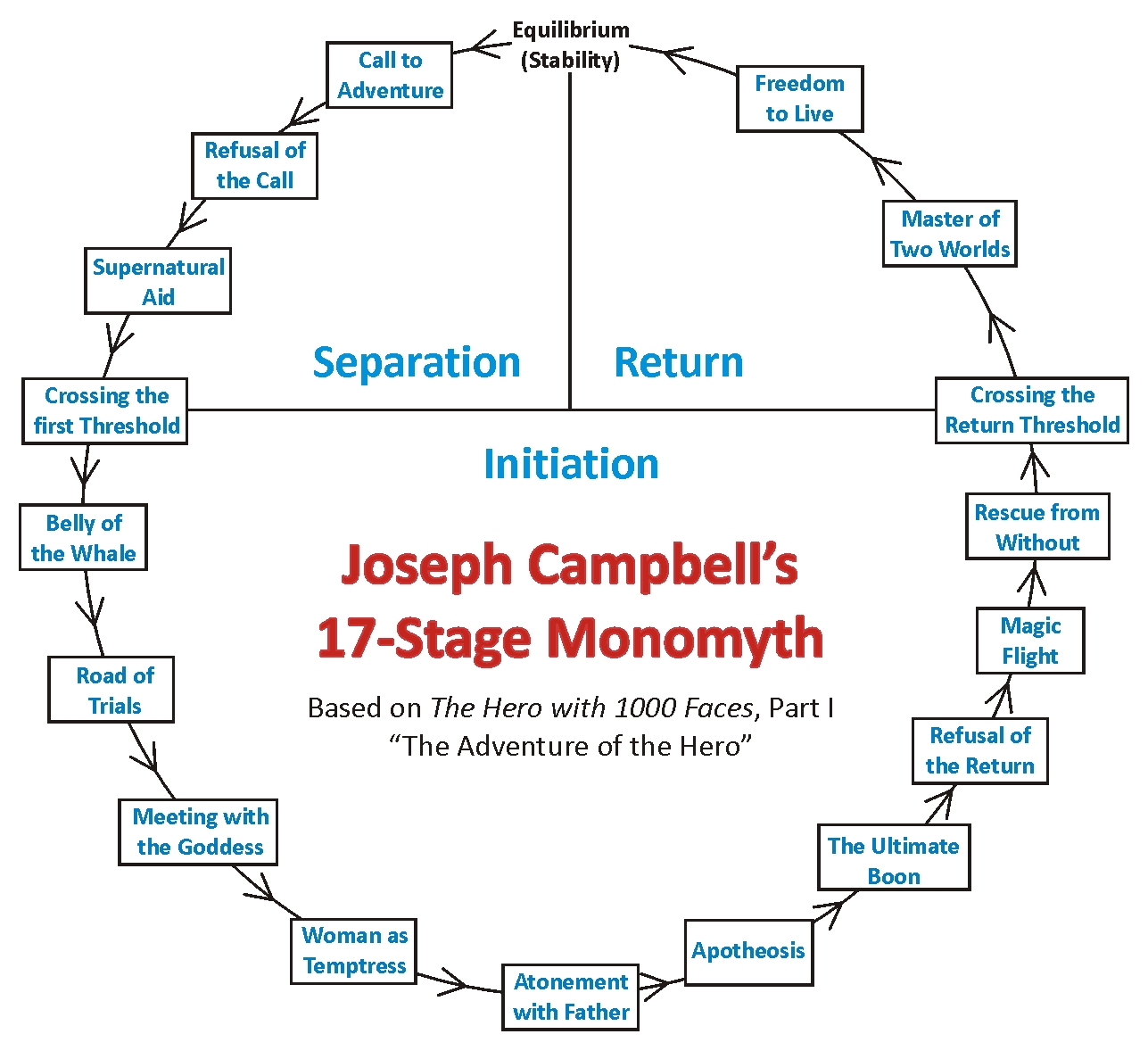
Also archetypes. Aside from the three main plot events, the monomyth is comprised of several archetypes. These are characters that fulfill major roles in the story and represent a psychological mechanism all humans face. The hero, mentor, and villain are just a few of the basic archetypes that comprise the monomyth.
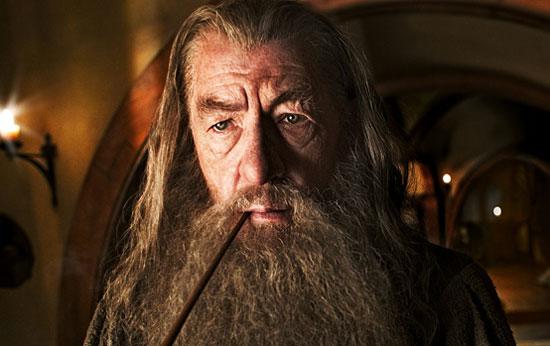 |
| Gandalf is the epitome of the mentor archetype. |
3. WHY IS THE MONOMYTH IMPORTANT?
Helps writers write, right. On the surface level, the monomyth is a great tool for storytellers. It is great template to structure their work on. It also provides the writer a map to reference if they feel their story has gone off of the beaten path.

Gives us insight into our own lives. On a deeper level, the monomyth helps us evaluate our own lives. Whether you’re writing a novel, going out on a date, or giving a job interview, we all tell stories everyday. But what we don’t realize is that all of us are living a story. The story of our life. For example, when a young man or woman accepts the call to adventure and joins the military, they leave their normal world. They are confronted with new obstacles and challenges in the proceeding years. And at some point, they leave the military and return back to society. Changed forever, by their experiences. Moreover they use the lessons they learned to make the normal world a better place.The same thing happens to students who attend a new school. Or a couple who become parents. On a personal level, the monomyth provides us a means to regard our own narrative. To help us understand our failures and successes in a meaningful way.

CONCLUSION
Again this was just a very simple overview. But the three key take-aways are as follows, 1) Monomyth means the “one story,” and elements of the monomyth can be found in nearly all forms of mythology and fairy tales from around the world; 2) It’s comprised of a three act structure, and has several recurring archetypes; 3) it’s basic uses are for writing and story structure. However, many people find it as a helpful tool in deciphering life experiences and gaining a deeper understanding of their own life’s story.
As I mentioned before, this post is just to cover the the basics of the Monomyth. Over the course of the next few months I intend to provide several in depth explanations on the different aspects of the Hero’s Journey, and analyze more advanced steps in the narrative structure.
If you’d like to hear more about the Monomyth and Hero’s Journey, feel free to watch my YouTube video on it here:
Follow Josh onYouTube here: https://www.youtube.com/user/Tipperdy
Or Twitter: @Joshumusprime
Or Twitter: @Joshumusprime
Or Facebook: www.facebook.com/thepolymathparadigm
And you can his NaNo progress here: http://nanowrimo.org/participants/tipperdy
And he has a book on military transitions here: http://www.amazon.com/About-Face-Josh-Coker-ebook/dp/B00N4GYB84/
Subscribe to:
Posts (Atom)